

A New Framework
Classification of Rack Densities
Rack Density quantifies how much power an IT Equipment Rack can consume. Each category in our framework doubles from one to the next, borrowed from the telecommunications radio spectrum.
What are Rack Densities?
Rack Density is a measure or metric that quantifies how much power an IT Equipment Rack (also applicable to Telco Racks) can consume. It might refer to:
Average Rack Density: Average of Rack Power Consumption of a group of racks.
Design Rack Density: Maximum (peak) power at which an IT Rack is designed.
Rack Density correlates directly to hardware applications — servers, networking, storage, and determines the capacity of electrical components, distribution systems, and thermal systems at the facility level.
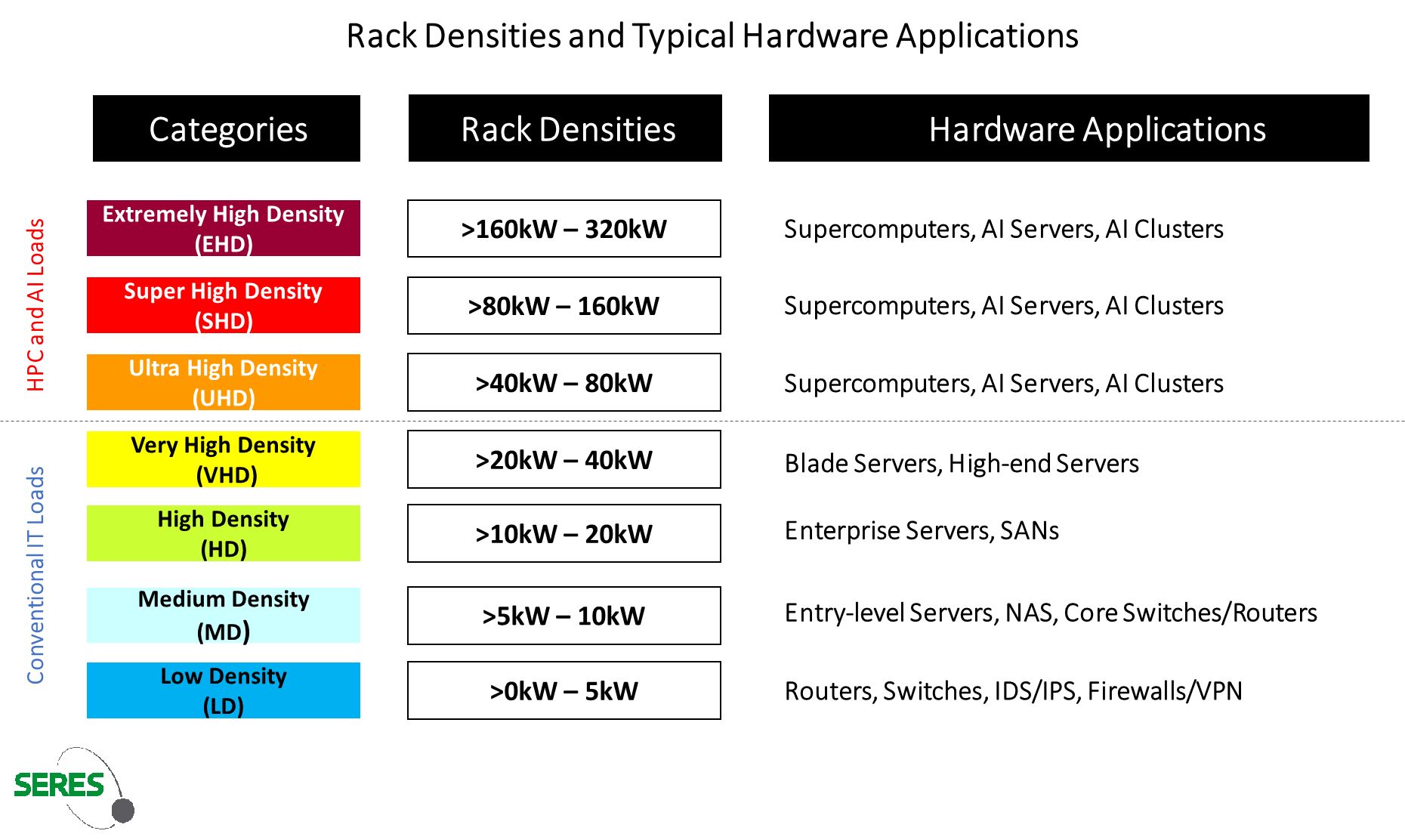
Each Density Category translates to a typical hardware profile and a suitable cooling technology. Conventional IT loads remain at or below 40 kW per rack; HPC and AI loads typically exceed 40 kW per rack.
Rack Density Categories
Seven categories — from LD to EHD
VHD (20–40 kW) is a bridge category that can support both conventional IT loads and some AI loads.
| ABBR. | RACK DENSITY CATEGORY | RANGE |
|---|---|---|
| LD | Low Density | › 0 kW – 5 kW |
| MD | Medium Density | › 5 kW – 10 kW |
| HD | High Density | › 10 kW – 20 kW |
| VHD | Very High Density | › 20 kW – 40 kW |
| UHD | Ultra High Density | › 40 kW – 80 kW |
| SHD | Super High Density | › 80 kW – 160 kW |
| EHD | Extremely High Density | › 160 kW – 320 kW |
Up to 40 kW / Rack
Greater than 40 kW / Rack
Cooling Technologies and Rack Densities

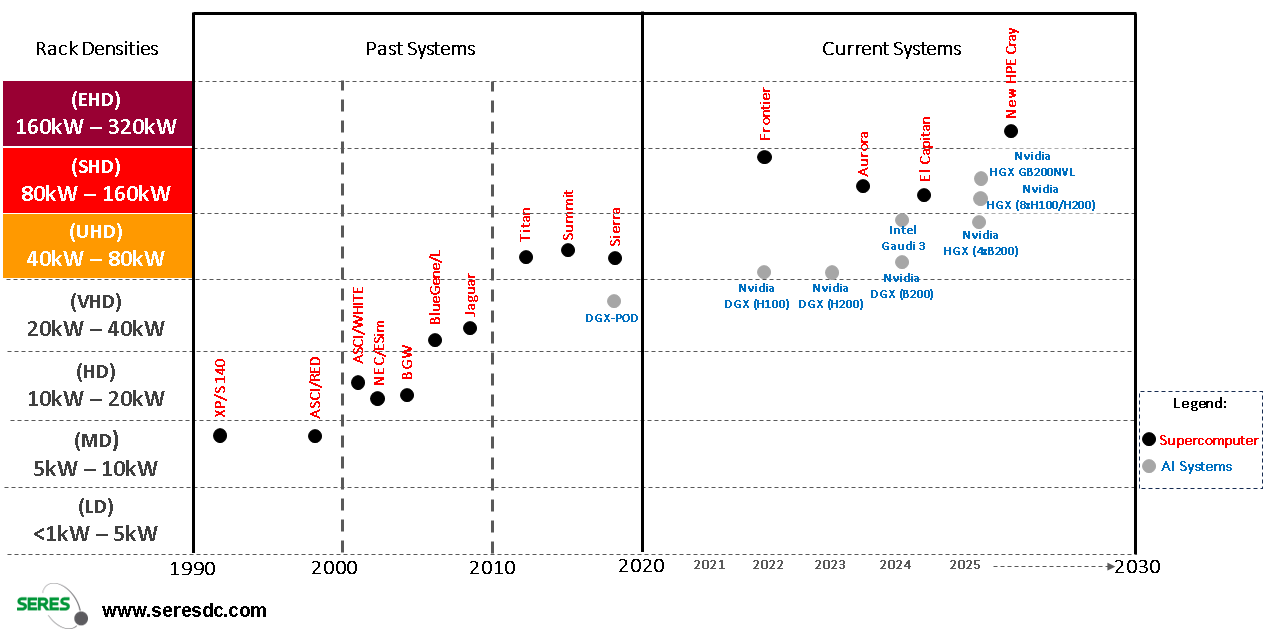
HPC vs AI Systems Rack Densities Trend
Understanding Rack Densities with their corresponding most useful cooling technology.
Rack Densities help in identifying and correlating:
IT Equipment power pattern
IT Equipment types/Performance
Cooling Technologies
Comparing Supercomputers with AI Systems, gives a sense of where we are today in terms of relative power consumption. AI Systems, should surpass Supercomputers in terms of Rack Density, possibly in this very decade, because of the market development pressure.

Understanding Extreme Rack Densities
Credits: Oak Ridge National Laboratory
Extremely High Rack Densities
Extremely High Rack Densities are related to potential future HPC and AI Loads
Comprises of four additional Rack Density categories related to the EHD (Extremely High Density) category (EHD: >160kW to 320kW)
Very EHD
2xEHD
>320kW to 640kW
500 kilowatt Category
VEHD
Ultra EHD
4xEHD
>640kW to 1280kW
1 Megawatt Category
UEHD
Super EHD
8xEHD
>1280kW to 2560kW
2 Megawatt Category
SEHD
Extremely EHD
16xEHD
>2560kW to 5120kW
3-5 Megawatt Category
EEHD
EHD
>160kW to 320kW
How New Rack Density Categories help Comparing Scenarios

Our New training dedicated on how to support AI Systems (Hardware) in the Data Center is here, please take a look at:
A Glimpse into the future.
We created this Rack Density framework to better understand, and being able to compare different systems and technologies related to IT power density.
We are very close to enter into the arena of EHD (Extremely High Density) Rack Density, according to our framework it starts at 160kW/Rack.